
Lab automation is worth it for small labs when it reduces manual work, improves throughput, lowers error risk, and supports future growth. But the real question isn't whether automation can help. It's whether the investment makes sense for your specific workflows, volume, and constraints.
ROI for lab automation for small labs depends on several factors: workflow volume, labor hours spent on repetitive tasks, bottlenecks that limit throughput, quality requirements, and scalability needs. Small labs don't need to automate everything at once. Many labs start with one focused workflow, validate ROI, and expand automation incrementally as throughput and complexity grow. The labs that succeed start with one high-impact workflow, prove value quickly, and expand from there.
This post breaks down how small labs can evaluate automation ROI, which processes to automate first, and how to take a staged approach that grows with your needs.
How Small Labs Can Measure Lab Automation ROI
The practical math for small lab automation ROI is straightforward: fewer FTE hours spent on repetitive tasks + higher throughput + fewer errors = potential payback.
Common ROI inputs include:
- Time spent on manual tasks: If your team spends 10 hours per week on manual plate handling, that's 520 hours annually. What's that time worth? What could your scientists do with those hours instead?
- Samples processed per day/week: If manual processes limit you to 50 samples per week and automation could handle 100 samples with the same staff, you've doubled capacity without adding headcount.
- Rework caused by manual errors: Manual pipetting introduces variability. If manual errors lead to repeat testing or reruns, automation may help reduce wasted reagents, instrument time, and staff hours.
- After-hours or unattended run potential: Automation extends operations beyond standard work hours. Workflows that previously required weekend staff can now run unattended, adding capacity without overtime costs.
- Staff capacity for higher-value scientific work: When automation handles routine tasks, scientists can focus on experimental design, data analysis, and method development rather than repetitive pipetting.
For more on measuring automation impact, see our guide on what makes automation accessible for labs of any size.
Successful automation is not only a scientific decision. It is also an engineering challenge involving instrument coordination, workflow scheduling, data movement, and system reliability. Small labs often see the most value from automation platforms that simplify these operational layers instead of adding unnecessary complexity. Biosero can help labs identify which workflow has the strongest automation opportunity before investing in a larger system. Starting with workflow analysis ensures you're automating the right processes for maximum impact.
What Lab Processes Should Small Labs Automate First?
Focus on repetitive, rules-based workflows with clear SOPs. The best candidates for lab automation investment share these characteristics: high volume, frequent repetition, well-defined process steps, and measurable impact when optimized.
Examples include:
- Liquid handling: Serial dilutions, plate reformatting, reagent dispensing
- Plate movement: Transferring plates between instruments without manual intervention
- Sample preparation: Automated extraction, normalization, or aliquoting
- Barcode scanning and sample tracking: Eliminating manual data entry and tracking errors
- Repetitive assay setup: Standardized protocols that run identically every time
The best starting point is often the workflow creating the biggest bottleneck. If sample prep limits your throughput, start there. If manual plate transfers between instruments create delays, automate that handoff. If pipetting errors force frequent reruns, prioritize liquid handling.
GoSimple Workcells are a potential fit for labs looking to start with a focused, pre-configured small workcell. These standardized systems target specific partner instruments (such as Sartorius Octet or BD flow cytometers) and deliver walk-away efficiency from day one without extensive customization.
GoDesigned Workcells work for labs that need a fully tailored system built around complex workflows or unique requirements beyond a standardized starting configuration.
Start Small: A Staged Approach to Lab Automation
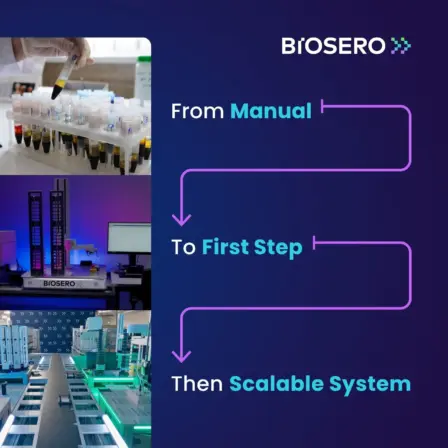
Small labs can begin with a focused workcell instead of a full lab transformation. Biosero's staged approach follows a simple path: start with one workflow, validate results, and expand modules or capabilities over time.

Start With One High-Impact Workflow
Choose a workflow with enough volume, repetition, and clear process steps to justify automation. The first automation project should prove value quickly, building confidence for future investment.
Look for workflows where:
- Manual execution takes significant time each week
- Process steps are well-defined and repeatable
- Bottlenecks limit overall lab throughput
- Errors or variability impact data quality
- An after-hours operation would add meaningful capacity
The goal isn't perfection. It demonstrates that automation works for your team, workflows, and constraints.
Validate the Results Before Expanding
Measure improvements in throughput, hands-on time, error reduction, and consistency. Track the same metrics you used to justify the initial investment. Early results support future automation decisions and help identify the next workflow to automate.
Key validation metrics to monitor for lab automation success can be:
- Throughput increase (samples per week before vs. after)
- Labor hours saved (time scientists spend on manual tasks)
- Error rate reduction (percentage of runs requiring rework)
- Consistency improvements (run-to-run variability)
- After-hours capacity added (weekend/overnight throughput)
Use these results to build the business case for expanding automation to additional workflows or adding capabilities to existing workcells.
Add Modules or Workcells as Needs Grow
Scalable lab automation solutions allow small labs to expand gradually without having to start over. The automation architecture you choose initially should support growth through modular additions rather than requiring complete rebuilds.
GoDesigned Workcells and Green Button Go Scheduler are relevant to scaling workflows and connecting devices into a more coordinated system. GBG Scheduler orchestrates instruments, schedules tasks, and manages data flows as you add new capabilities.
Green Button Go Scheduler supports individual workcell coordination, while Green Button Go Orchestrator becomes relevant as labs scale into broader multi-system automation environments. At that stage, it can coordinate complex, multi-instrument workflows and integrate with LIMS, ELNs, and other lab software platforms.
How Biosero Helps Small Labs Automate Strategically
Biosero can help labs identify the right starting workflow, design a scalable workcell, and support long-term automation growth. The approach focuses on delivering immediate value while building infrastructure that expands with your science.
- GoSimple Workcells for focused, pre-configured automation entry points: Start small without overbuilding. These ready-to-run systems target specific instruments and workflows, designed to provide walk-away efficiency with minimal customization and faster deployment than traditional custom automation projects. Best fit for labs taking their first automation step with partner instruments like Sartorius Octet or BD flow cytometers.
- Green Button Go Scheduler for coordinating instruments and improving hands-off operation: Reduce hands-on time, coordinate devices, and support unattended workflows. GBG Scheduler manages task scheduling, instrument coordination, and data tracking across your workcell. Best fit for ROI: extends runtime into nights and weekends, reduces manual handoffs, and maximizes instrument utilization.
- GoCare Support and the Biosero Portal for ongoing support, software upgrades, documentation, training resources, and technical support: Long-term support, updates, and technical help after launch. Small labs benefit from knowing expert support is available when questions arise and that software updates, documentation, training resources, and troubleshooting assistance remain accessible through the Biosero Portal. Best fit for small lab confidence: reduces dependence on internal automation expertise and protects your automation investment over time.
Ready to Get Started with Small Lab Automation?
Small labs do not need to automate everything at once to see meaningful value. The right starting point is a focused workflow that reduces manual work, improves consistency, and creates room to scale as needs grow.
Biosero can help identify the best first automation opportunity for your lab, design a workcell that fits your workflow, and support long-term growth through Green Button Go software, GoCare support, and scalable automation solutions.
Contact Biosero to discuss how your lab can start small, prove ROI, and build toward a more automated future.
Lab automation is not only for large labs. Small labs can benefit from automation when it reduces repetitive manual work, improves consistency, and helps teams increase throughput without immediately adding headcount.
The cost of lab automation for a small lab depends on workflow complexity, number of instruments, software needs, and support requirements. A focused workcell is typically a more practical starting point than a full-lab automation buildout.
The best first workflow to automate is usually the one creating the biggest bottleneck, such as repetitive liquid handling, sample preparation, plate movement, or assay setup.
Small labs can expand automation over time by starting with one focused workcell, validating ROI, and adding instruments, modules, or broader orchestration as workflows scale and needs grow.