

Automating analytical chemistry
Analytical chemistry
Automating analytical chemistry

Custom methods for identifying, characterizing, and quantifying formulations are subject to change. Leverage Biosero's hardware-agnostic automation approach to accelerate current workflows without sacrificing the data generated.

3 reasons to automate analytical chemistry
Automating custom sample preparation
Reducing errors from manual sample prep and freeing up valuable time for scientists
Simplify complex compound analysis
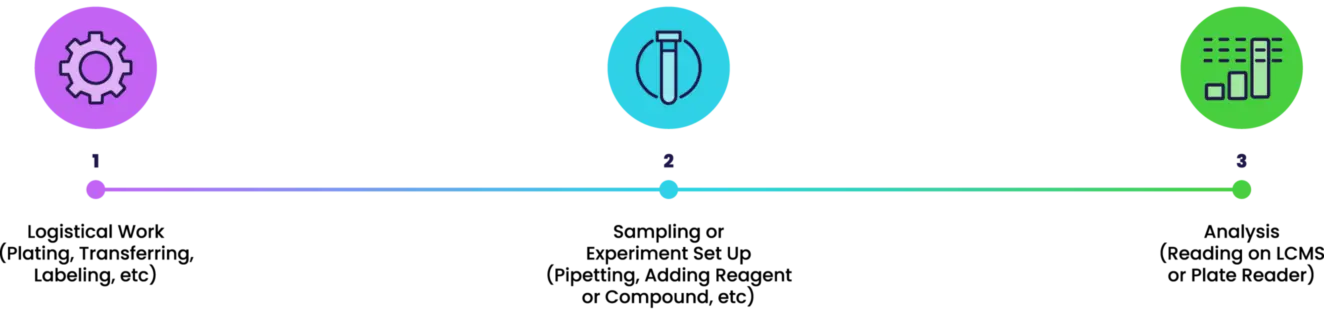
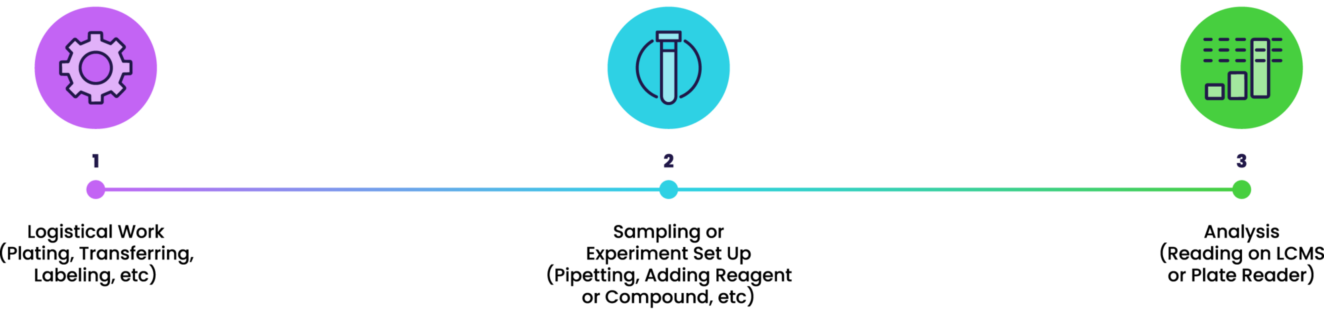
Instead of running one experiment at a time, chain analyses together to extract rich data at the push of a button
Manage time-intensive experiments with automated scheduling
Dynamically schedule recurring assays at pre-determined times for increased analytical throughput and data transfer


Example analytical chemistry workcells
No matter your goals or throughput needs, we can design and implement a solution to automate your Analytical Chemistry workflow.
Small workcell
Small workcell
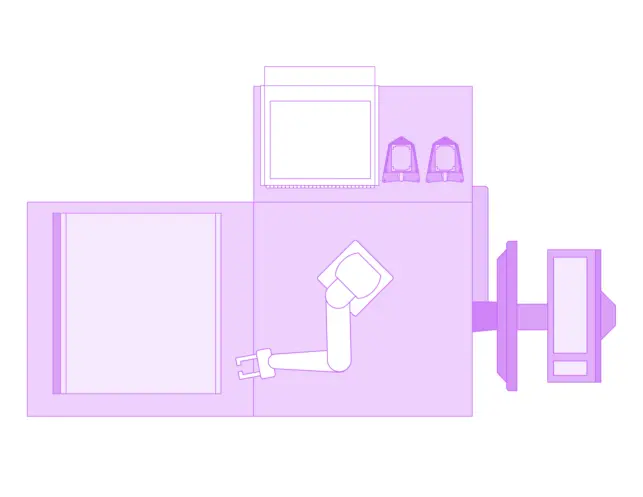
This workcell automates key steps in analytical chemistry to ensure precise sample preparation and consistent reagent handling for high-quality data. This setup enhances reproducibility, reduces turnaround time, and supports walkaway operation for demanding workflows.
Feature details for Hardware
Hardware:
Agilent LCMS
Lynx700 Liquid Handler
UR5 Robotic Arm
2x Plate Hotels
Feature details for Software
Integration Software:
Green Button Go Scheduler
Feature details for Hardware
Hardware:
Agilent LCMS
Lynx700 Liquid Handler
UR5 Robotic Arm
2x Plate Hotels
Feature details for Software
Integration Software:
Green Button Go Scheduler
Medium workcell

Medium workcell
This workcell supports high-throughput analytical workflows. Samples are automatically prepared, tracked, and processed through tightly controlled conditions to ensure consistent assay setup and data integrity. The combination of incubation, spectrophotometry, and chromatography enables multi-dimensional analysis with minimal user interaction. This system maximizes walkaway time, improves traceability, and delivers robust, reproducible results for complex analytical applications.
Feature details for Hardware
Hardware:
PF400 on 1.5M Rail
Hamilton STAR
LiCONiC STX500
Scinomix VXL
Azenta FluidX IntelliXcap
BMG SpectroSTAR
1x Plate Hotels
Feature details for Software
Integration Software:
Green Button Go Scheduler
Feature details for Hardware
Hardware:
PF400 on 1.5M Rail
Hamilton STAR
LiCONiC STX500
Scinomix VXL
Azenta FluidX IntelliXcap
BMG SpectroSTAR
1x Plate Hotels
Feature details for Software
Integration Software:
Green Button Go Scheduler
Large workcell

Large workcell
This fully integrated system enables seamless, unattended preparation of analytical-ready samples from long-term storage through final analysis. It delivers high-throughput, reproducible processing with complete traceability across complex chemistry workflows. The workcell is divided into two zones—Storage and Tube Analysis, and Sample Preparation—connected by a central honeycomb module for automated transfer of plates and tube racks.
Feature details for Hardware
Hardware:
C5 on 2M Rail Robotic Arm
Beckman Coulter Biomek i7
Genevac EZ-2 Evaporator
Thermo Fisher Cytomat Skyline
Sirius Omnitasker
Waters UPLC
Waters Autopurification System
Hamilton Storage Verso Q75
Feature details for Software
Integration Software:
Green Button Go Scheduler
Feature details for Hardware
Hardware:
C5 on 2M Rail Robotic Arm
Beckman Coulter Biomek i7
Genevac EZ-2 Evaporator
Thermo Fisher Cytomat Skyline
Sirius Omnitasker
Waters UPLC
Waters Autopurification System
Hamilton Storage Verso Q75
Feature details for Software
Integration Software:
Green Button Go Scheduler
Best use cases for bringing in automation
Labs with regularly scheduled workflows
High-throughput demands
Staff is tasked with many responsibilities beyond the bench or off-hour staffing is leveraged
What to watch out for
Labs may encounter delays due to manual review or release of samples coming off the system, especially if human verification is still required
The lab's LIMS or ELN infrastructure must be capable of handling the increased data volume generated by automated runs
Waste management should be considered, as automation typically results in higher consumption of labware and tips, which must be accounted for in both cost and disposal logistics